A resurrection of sorts is in the cards for this blog. Stay tuned for more in the very near future!
Sincerely,
The Aesthete
Saturday, July 5, 2014


Wednesday, December 1, 2010
Some wonderful winter cocktails
I've been horribly, unforgivably remiss in updating this, my poor forgotten blog. I intend to make it up to you this holiday season, dear reader. My penance will begin with this brief post.
Here's an inspired article from The New York Times on seasonal cocktails, all of which I am eager to sample. When I do, I'll be sharing my comments and notes with you here.
Here's an inspired article from The New York Times on seasonal cocktails, all of which I am eager to sample. When I do, I'll be sharing my comments and notes with you here.
Saturday, March 20, 2010
The French "75" Cocktail
"Hits with remarkable precision."
-Harry Craddock, The Savoy Cocktail Book

We concede that this is truly the best way to make a French 75. Slightly adapted from The Savoy Cocktail Book:
The French "75" Cocktail
2 ounces Dry Gin
1 ounce Fresh Lemon Juice
1 teaspoon Sugar or Simple Syrup
Shake the above ingredients together with ice in a cocktail shaker; strain into an appropriate glass and fill with Champagne.
If you make these for guests, expect to spend the evening making them over and over again.
Monday, March 1, 2010
Sucré
While we were in New Orleans, we came across Sucré, a sweet shop located at 3025 Magazine Street. Self-described as an "emporium of 'artisan' sweets," Sucré has an amazing range of delectable treats. We had coffee and this gorgeous chocolate raspberry confection that I cannot remember the name of:

The name of it, obviously, does not matter. It's difficult to see in the photograph, but it actually sparkles. For those traveling in New Orleans who have any sort of sweet tooth, a visit to Sucré is mandatory. For everyone else at home, you can order beautiful treats, like chocolates and macaroons, from Sucré online at their website.
Sazerac
Arguably the world's first cocktail, born in New Orleans in 1838, the Sazerac has an interesting history which you can peruse at the official Sazerac Company site. In mixing ours at Mardi Gras we strictly followed the official Sazerac recipe, which you can find here, and the only adaptation made was we doubled the recipe. I am interested in experimenting with the more historic versions that they mention in passing, especially where they involve employing true absinthe instead of Herbsaint. As it was, we were delighted with the official version. We used Buffalo Trace Bourbon, as you can see below. You can also use Sazerac Kentucky Straight Rye Whiskey. Interestingly enough, the original version was made with brandy, so feel free to try that too.

One of the most characteristic ingredients in the Sazerac cocktail is the Peychaud's bitters. Antoine Peychaud, the Creole pharmacist (from Saint-Domingue, now Haiti) who invented the Sazerac, created his concoction of aromatic cocktail bitters in the early 1830s, which are still named after him. In New Orleans, you can easily find Peychaud's bitters in grocery stores, as we did:

Peychaud's bitters are also available on the internet, of course, and you can purchase them online at Bowery & Vine.
The disappearance of February.
February departed so suddenly! My negligence is truly unforgivable, and to make it up to you, I'll be posting now everything I had intended to post during the latter part of February. I'd like to make the excuse that Mardi Gras had a tremendous effect on me and the hangover lasted two weeks, but that isn't even remotely close to the truth. In fact, my general sobriety during the occasion was fairly disconcerting. I did sample a Sazerac, and we also came across a very lovely dessert boutique on Magazine Street called Sucré, all of which you can read about in the very near future.
Saturday, February 13, 2010
The Aesthete Abroad
Off to New Orleans for Mardi Gras; when I return, I will be exploring cocktails specific to that city. The following is a photograph of the New Orleans Pharmacy Museum. I'd really love to have one of these to decorate my home someday.

On my list of cocktails to explore is the Sazerac (perhaps the first cocktail of all cocktails), the Hurricane, and Absinthe Frappé. If you have any suggestions, please feel free to mention them in the comments.
Wednesday, February 10, 2010
Sidecars

The sidecar is a straightforward concoction, consisting of equal parts cognac or brandy, lemon juice, and Cointreau. Like most cocktails, it has an obscure history, but it is one of the many cocktails to emerge after the first world war. It can also be prepared with two parts cognac, one part lemon juice, and one part Cointreau; this is how it's done in the 1930 Savoy cocktail book. It's usually served with a lemon twist or a sugared rim. I recommend adapting the Sidecar to suit your tastes, because it is a such a lovely, simple drink. That said, this is how we prepare them:

Sidecars, for Two Aesthetes
2 ounces brandy
(or cognac)
(or cognac)
2 ounces Cointreau
2 ounces fresh lemon juice
1/2 teaspoon sugar
(optional)
(optional)
Combine lemon juice and sugar, if desired, and pour into a cocktail shaker. Add the brandy or cognac and Cointreau. Shake vigorously with ice, and pour into cocktail glasses. Serve with a lemon twist.
Saturday, January 30, 2010
Grapefruit Au Cointreau
It is my intention to not only post cocktails I'm exploring, but comestibles as well. When those two categories are combined, better and better. The following is an example of both and makes for a marvelous breakfast dish.

Slice one cocktail grapefruit in half. Pour 1 Tablespoon Cointreau over each side and adorn with maraschino cherries, if desired. The grapefruit halves can be refrigerated for several hours, or overnight. Serves two.
Adapted from The Gourmet's Guide to Dining and Drinking, a Cointreau advertisement recipe booklet from the 1950s.
Saturday, January 23, 2010
Blood Orange French 75s

Blood Orange French 75s are an exquisite, temporal concoction, as blood oranges are only available in the winter months (as in, January and February). To make them: extract the juice from one or several blood oranges, and create a mixture that is half blood orange juice, half dry gin. Shake with ice in a cocktail shaker. Pour into champagne flutes, filling one-third to half full. Top off glasses with champagne. Imbibe and enjoy.
This is a wonderful solution for all sorts of social gatherings, from dinners to improvised birthday parties.

Tuesday, January 19, 2010
Corpse Reviver No. 2

Whenever you feel lifeless and find your corpse in need of revival, I highly recommend trying out the following concoction: the Corpse Reviver No.2 from the 1930 Savoy cocktail book.
1/4 Wine Glass Lemon Juice
1/4 Wine Glass Kina Lillet (lillet blanc, for those mixing in the 21st century)
1/4 Wine Glass Cointreau
1/4 Wine Glass Dry Gin
1 Dash Absinthe
Place in a cocktail shaker with ice and shake vigorously; strain into a cocktail glass.
According to Harry Craddock, compiler of the Savoy Hotel Cocktail Book, "Four of these taken in swift succession will unrevive the corpse again." From experience, I would also like to note that the reviving effects wear off after one hour.
Thursday, January 7, 2010
Champagne Cocktail
I first became aware of the existence of the Champagne Cocktail when I first became aware of the film Casablanca. Set in French Morocco during the second World War, it's a gorgeous melodrama with everyone in it, from Bogart and Bergman to Lorre and Veidt. The subject of the film is the refugee trail that the war brought about, so upon reflection, it takes a stretch of the imagination to believe that these people have time to sit around Rick's Café Américain and drink champagne cocktails, but they do. Paul Henreid's character orders one at the bar as a cover for the fact that he's meeting with a member of the Free French.

Place a sugar cube in a champagne glass and saturate with Angostura bitters. Crush the sugar cube and make sure it is well combined with the bitters. Fill glass with chilled champagne, and imbibe. Pairs well with celebrations of all kinds and the film Casablanca.
It's also worthwhile to quote The Savoy Cocktail Book from 1930 with recipes compiled by Harry Craddock:
Put into a wine glass one lump of Sugar, and saturate it with Angostura Bitters. Having added to this 1 lump of Ice, fill the glass with Champagne, squeeze on top a piece of lemon peel, and serve with a slice of orange.
It's also worthwhile to quote The Savoy Cocktail Book from 1930 with recipes compiled by Harry Craddock:
Put into a wine glass one lump of Sugar, and saturate it with Angostura Bitters. Having added to this 1 lump of Ice, fill the glass with Champagne, squeeze on top a piece of lemon peel, and serve with a slice of orange.
Monday, December 21, 2009
The French 75, Part I.

The French 75 is a historic cocktail which, strangely enough, can be made with gin and Champagne, or Cognac and Champagne. It was invented either during World War I or immediately thereafter, and it is named after the French 75mm field gun. As far as I can tell, the combination of gin and Champagne predates the Cognac and Champagne version that is perhaps more familiar today. (I intend to examine the question more closely, but as the 1930 Savoy cocktail book gives the recipe as involving gin and Champagne with no variations, I am inclined to believe that the Cognac is a later addition.)
That said, I will now furnish you with the French 75 recipe with Cognac, because it is well worth sharing:

1 ounce Cognac
a teaspoon of sugar
1/2 ounce fresh lemon juice
Champagne to fill the glass
Combine the Cognac, sugar, and lemon juice in a cocktail shaker and shake vigorously. Strain into a well-chilled Champagne glass, and fill to the top with Champagne.
More on other variations later, especially the classic gin and Champagne version. Also, in the near future: Corpse Revivers.
Sunday, December 6, 2009
Death in the Afternoon
Death in the Afternoon is a novel, as well as a cocktail, by Ernest Hemingway. The cocktail consists of absinthe and Champagne, and was named after the book. According to Absinthe Online its origin is as follows:
A recipe verified in the 1935 humoristic celebrities' cocktail book titled
So Red the Nose, or Breath in the Afternoon edited by the famous journalist and author Sterling North and Carl Kroch.
Hemingway wrote: "This was arrived at by the author and three officers of the H.M.S. Danae after having spent seven hours overboard trying to get Capt. Bra Saunders' fishing boat off a bank where she had gone with us in a N.W. gale."
In his article Trying to Clear Absinthe’s Reputation for The New York Times, Harold McGee gives Hemingway's original recipe:
Death in the Afternoon
Pour one jigger absinthe into a Champagne glass. Add iced Champagne until it attains the proper opalescent milkiness. Drink three to five of these slowly.

We do not recommend actually drinking three to five of these, unless your intention is suicide in the afternoon. Additionally, we do not recommend breaking out serious Champagne for this cocktail; a nice sparkling wine will do. Pick something low in acidity and not too dry. We find that Asti Spumante performs admirably.
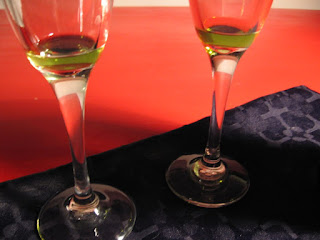
This is how much absinthe we use, not even a third of what Hemingway recommends. One jigger (1.5 ounces, 44 mL) is vastly more than enough absinthe; we use about a third of an ounce, and we are people who deeply enjoy absinthe. If this is your first time trying an absinthe cocktail, or you do not have a strong constitution where absinthe is concerned, I recommend putting just a drop or two in the glass and swirling it around to cover the sides before pouring in the sparkling wine. We used Absinthe Duplais Verte here, and enjoyed it immensely.
A recipe verified in the 1935 humoristic celebrities' cocktail book titled
So Red the Nose, or Breath in the Afternoon edited by the famous journalist and author Sterling North and Carl Kroch.
Hemingway wrote: "This was arrived at by the author and three officers of the H.M.S. Danae after having spent seven hours overboard trying to get Capt. Bra Saunders' fishing boat off a bank where she had gone with us in a N.W. gale."
In his article Trying to Clear Absinthe’s Reputation for The New York Times, Harold McGee gives Hemingway's original recipe:
Death in the Afternoon
Pour one jigger absinthe into a Champagne glass. Add iced Champagne until it attains the proper opalescent milkiness. Drink three to five of these slowly.

We do not recommend actually drinking three to five of these, unless your intention is suicide in the afternoon. Additionally, we do not recommend breaking out serious Champagne for this cocktail; a nice sparkling wine will do. Pick something low in acidity and not too dry. We find that Asti Spumante performs admirably.

This is how much absinthe we use, not even a third of what Hemingway recommends. One jigger (1.5 ounces, 44 mL) is vastly more than enough absinthe; we use about a third of an ounce, and we are people who deeply enjoy absinthe. If this is your first time trying an absinthe cocktail, or you do not have a strong constitution where absinthe is concerned, I recommend putting just a drop or two in the glass and swirling it around to cover the sides before pouring in the sparkling wine. We used Absinthe Duplais Verte here, and enjoyed it immensely.
Thursday, December 3, 2009
An Old-Fashioned Old Fashioned

We decided to make Old Fashioned cocktails the other night, after we discovered that we had all the necessary ingredients. The recipe originates from George J. Kappeler's formidable book Modern American Drinks: How to Mix and Serve All Kinds of Cups and Drinks, published in 1895.
Old-Fashioned Whiskey Cocktail
Dissolve a small lump of sugar with a little water in a whiskey glass; add two dashes Angostura bitters, a small piece of ice, a piece lemon peel, one jigger whiskey. Mix with small bar spoon and serve, leaving spoon in glass.
A jigger is equal to 1.5 ounces and 44 milliliters.

Everything assembled; we realized that the maraschino cherries were not necessary for the 1895 version after we took the photograph. You can include them if you like, but we garnished with the lemon peel alone.

Before we put in the whiskey. As demonstrated above, we obviously used Bourbon whiskey. Kappeler's recipe doesn't specify what sort to use, but Bourbon is traditionally held to be what one puts into an Old Fashioned.
In conclusion,
A good drink at the proper time
Has a welcome in every clime
-George J. Kappeler, Modern American Drinks: How to Mix and Serve All Kinds of Cups and Drinks, 1895.
Tuesday, December 1, 2009
The Perfect Manhattan

A traditional Perfect Manhattan consists of the following:
2 ounces rye whiskey
1/2 ounce sweet vermouth
1/2 ounce dry vermouth
a dash of bitters
All of which you swirl with ice in a cocktail shaker, pour into an appropriate glass, garnish with a maraschino cherry, and imbibe.
The Perfect Manhattan differs from the Manhattan in that it includes dry vermouth as well as sweet: in my experience, a Perfect Manhattan is a vastly better cocktail than a Manhattan. When we made Manhattans, we were considerably overwhelmed with the strange, sickly taste of sweet vermouth, and note that we followed traditional proportion to the letter. I felt like I was gagging on an elderly gentleman's cologne. My husband said, "This is what you drink when you're down on your luck." I said, "This is what you drink when you're trying to forget a World War."
When we made our Perfect Manhattans the other night, we used Bourbon whiskey, in a nod to the film Some Like It Hot, which has a scene on a train where Marilyn Monroe and about twenty other blondes decide to improvise Manhattans, much to the consternation of Jack Lemmon's character, who is trying to make it with Marilyn Monroe despite the fact that he is in drag. Highlights of the scene (from a cocktail maker's point of view) include: one of the orchestra members shouting, "Hey, easy on the vermouth!" which is excellent advice, and Tony Curtis, who is also in drag, exclaiming, "Maraschino cherries?" in his Bronxite accent.
Apparently a Bronx is also a cocktail. We will explore it, and post about it in the near future. Next on our list of cocktails to share: Death In The Afternoon.
Thursday, November 26, 2009
New England Apple Pie Or A Recipe For Vengeance
From A Tramp Abroad, By Mark Twain
To make this excellent breakfast dish, proceed as follows: Take a sufficiency of water and a sufficiency of flour, and construct a bullet-proof dough. Work this into the form of a disk, with the edges turned up some three-fourths of an inch. Toughen and kiln-dry it a couple of days in a mild but unvarying temperature. Construct a cover for this redoubt in the same way and of the same material. Fill with stewed dried apples; aggravate with cloves, lemon-peel and slabs of citron; add two portions of New Orleans sugar, then solder on the lid and set in a safe place till it petrifies. Serve cold at breakfast and invite your enemy.
I admit that this is not the recipe I employed to make my apple pie this year, but I thought it would be more interesting to share this one with you.
To make this excellent breakfast dish, proceed as follows: Take a sufficiency of water and a sufficiency of flour, and construct a bullet-proof dough. Work this into the form of a disk, with the edges turned up some three-fourths of an inch. Toughen and kiln-dry it a couple of days in a mild but unvarying temperature. Construct a cover for this redoubt in the same way and of the same material. Fill with stewed dried apples; aggravate with cloves, lemon-peel and slabs of citron; add two portions of New Orleans sugar, then solder on the lid and set in a safe place till it petrifies. Serve cold at breakfast and invite your enemy.
I admit that this is not the recipe I employed to make my apple pie this year, but I thought it would be more interesting to share this one with you.
Tuesday, November 24, 2009
A nation is born stoic, and dies epicurean.
- Will Durant
I enjoy this quote immensely, and, as I did not quite know how to begin this inaugural post, I am glad to have the excuse of employing it here. My father said it to me the other day, and it made me laugh.
As modern people, when we use the term epicurean, we are referring to something very different than that which Epicurus intended.
Here's part of the Oxford English Dictionary definition of an epicure:
1. a. A philosopher of the school of Epicurus. Obs.
The distinctive doctrines of Epicurus were, 1. That the highest good is pleasure, which he identified with the practice of virtue. 2. That the gods do not concern themselves at all with men's affairs. 3. That the external world resulted from a fortuitous concourse of atoms.
b. loosely. One who disbelieves in the divine government of the world, and in a future life; one who recognizes no religious motives for conduct.
2. One who gives himself up to sensual pleasure, esp. to eating; a glutton, sybarite.
3. (The current sense.) One who cultivates a refined taste for the pleasures of the table; one who is choice and dainty in eating and drinking.
I suppose all this is intended as a sort of introduction. I love wordy definitions and satire as well as living well on a starving artist's income. I advocate only the most appealing forms of epicureanism. If your interests are similar, we will be in good company together. All I have left to say is welcome.
I enjoy this quote immensely, and, as I did not quite know how to begin this inaugural post, I am glad to have the excuse of employing it here. My father said it to me the other day, and it made me laugh.
As modern people, when we use the term epicurean, we are referring to something very different than that which Epicurus intended.
Here's part of the Oxford English Dictionary definition of an epicure:
1. a. A philosopher of the school of Epicurus. Obs.
The distinctive doctrines of Epicurus were, 1. That the highest good is pleasure, which he identified with the practice of virtue. 2. That the gods do not concern themselves at all with men's affairs. 3. That the external world resulted from a fortuitous concourse of atoms.
b. loosely. One who disbelieves in the divine government of the world, and in a future life; one who recognizes no religious motives for conduct.
2. One who gives himself up to sensual pleasure, esp. to eating; a glutton, sybarite.
3. (The current sense.) One who cultivates a refined taste for the pleasures of the table; one who is choice and dainty in eating and drinking.
I suppose all this is intended as a sort of introduction. I love wordy definitions and satire as well as living well on a starving artist's income. I advocate only the most appealing forms of epicureanism. If your interests are similar, we will be in good company together. All I have left to say is welcome.
Subscribe to:
Posts (Atom)
